
While the costs of assuming a stable world are increasing, disruption creates space for value creation, opening doors for fresh approaches. Uncertainty and fast-changing environments drive these opportunities. Disruptive thinking allows you to find gaps and explore them.
There have been two notable implementations of disruption:
- Creative Destruction : Coined by Joseph Schumpeter, describes the process by which an industrial mutation destroys an old paradigm. We define this as Disruption 1.0.
- Disruptive Innovation : Described by Clayton Christensen as the specific characteristics of how an innovative product typically disrupts an old market. This is Disruption 2.0.
While these describe many of the past decades’ disruptions, they are two discrete types of disruption. Looking forward, disruption is disrupting itself systemically. In the new era we define as Disruption 3.0, disruption is omnipresent. It is a constant which establishes entirely new paradigms, which themselves will evolve. Disruption is no longer a single event but a steady state, increasing in impact as spillover effects ricochet.
The drivers of disruption are interconnected like a network. These changes are systemic, representing a large-scale, multidimensional family of disruptions. Their collisions reinforce the already inherent complexities, paradoxes, and pluralism of today’s perspectives, problems, and responses.
Together, this environment conjures a new type of systemic disruption, which we label Disruption 3.0.
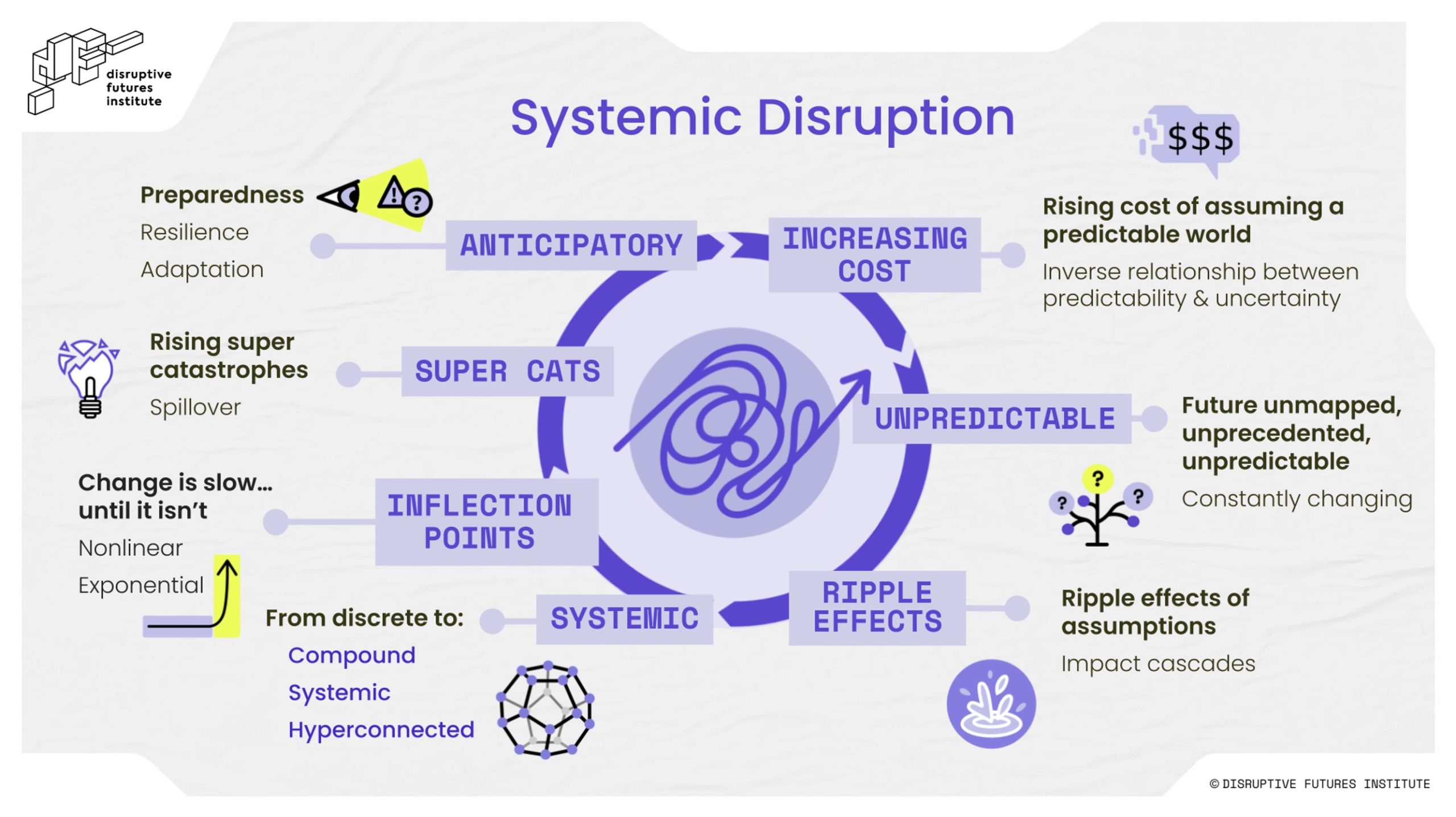
8 Ways Systemic Disruption Impacts Strategic Planning
Prognostication, which relies on modelable business environments, does not take systemic disruption into account. Strategic planning seeks predictions versus asking what future states could be. With systemic disruption, there are 8 limitations to relying on strategic planning approaches.
1. Increasing Cost of Business as Usual
The cost of continuing to run businesses as if the world is stable, linear, and compartmentalized is increasing. For those intent on business as usual, the scope of value destruction is growing.
The world’s increasing lack of predictability is evident in every aspect of life today, including the Covid pandemic, emerging technologies which disrupt incumbents, or the knock-on effects of geopolitical change (e.g. Russia’s invasion exacerbating inflation, cybersecurity risks, and the food and nuclear crises).
There is an inverse relationship between predictability and uncertainty.
2. The Domino and Ripple Effects of Assumptions
If next-order consequences of systemic disruption and impact cascades are not taken into account, continuity may be assumed. Assumptions are not self-contained perspectives isolated from the world or protected from unintended consequences. More often than not, wrong assumptions permeate. Domino effects give way to butterfly effects given nonlinearity.
“Outsized” conflates with “unpredictable” as a small cause yields disproportionate effects.
3. Data is Not a Proxy for the Future
You can number crunch every data point in the world; it will still be the past. As our world changes at warp speed, data will continue to misinform and prompt serious failures. Economic forecasts abound, but they did not protect the world from abruptly waking up to record inflation in 2022. Data can be valuable in simulation, but it must not be confused with prediction.
You can’t rely on modeling uncertainties to deliver certainty, especially in evolving volatile environments.
4. Traditional Planning Overemphasizes Trend Analysis
Trends measure change over time, using historic data values to extrapolate future possibilities. The greater the pace, nature, and velocity of change, the harder it may be to understand the long-term trajectory of an observed trend. They project a linear future based on fixed assumptions around their continuation. However insightful the analysis, data is always set in past context. Over-relying on trends is fraught with danger, not least the multiplying, self-reinforcing effect of flawed assumptions over time.
Trends are not the finality; they are an initial base from which to imagine possible futures.
5. We Are in a Complex Era – It’s Beyond Complicated
Complicated situations are ordered and predictable: there is a range of right answers; forecasts can be relatively accurate; we can rely on experts – and to a degree Artificial Intelligence – given known unknowns. In complex environments, we find multidimensional cause and effect, the potential for no right answers, unpredictability, nonlinear dynamics, emergent practices, interdependencies, and a whole with no clear relationship to its parts. In complex systems (nature, social networks, financial markets) outcomes cannot be predicted.
Complexity flies in the face of what is merely complicated, imposing limitations to our understanding.
6. From Discrete to Hyperconnected
Strategic analysis focuses on discrete risks and opportunities. Organizations and policymakers too often take a siloed approach to problems.
What happens when risks and impacts compound simultaneously? These are intersecting hazards at different levels, including natural disasters, food security, nuclear threats, the energy crisis, financial meltdowns, and even weaponized information threatening democracies. With compound risks, hazards increase in frequency, velocity, and intensity, intersecting at different levels.
Effective planning requires multi-disruption filters to evaluate feedback loops and interlinkages, rather than treat discrete, single disruptions as one-off events.
7. Rising Super Cats
« Destructive fires, a devastating drought, and torrential floods are each catastrophes in their own right – but when they overlap they are even more capable of causing calamity…» (source)
Super Cats (super catastrophes) rise beyond “isolated” catastrophes, compounding into loss amplifications. When hazards simultaneously combine, the overall effects spill over through our interdependent global systems.
These impacts are not siloed; likewise, neither should our approach to assessing risks and future-preparedness decisions.
8. The “Inflection Paradox”
Inflection points, or tipping points, arise when small changes interact and enable the emergence of watershed changes that replace past paradigms and assumptions.
Inflection points are moments when major shifts from one stage to another take place. They can be seen in social movements, technological innovations, and business transitions. Regardless of context, one cannot merely continue the same behavior after an inflection point and remain relevant.
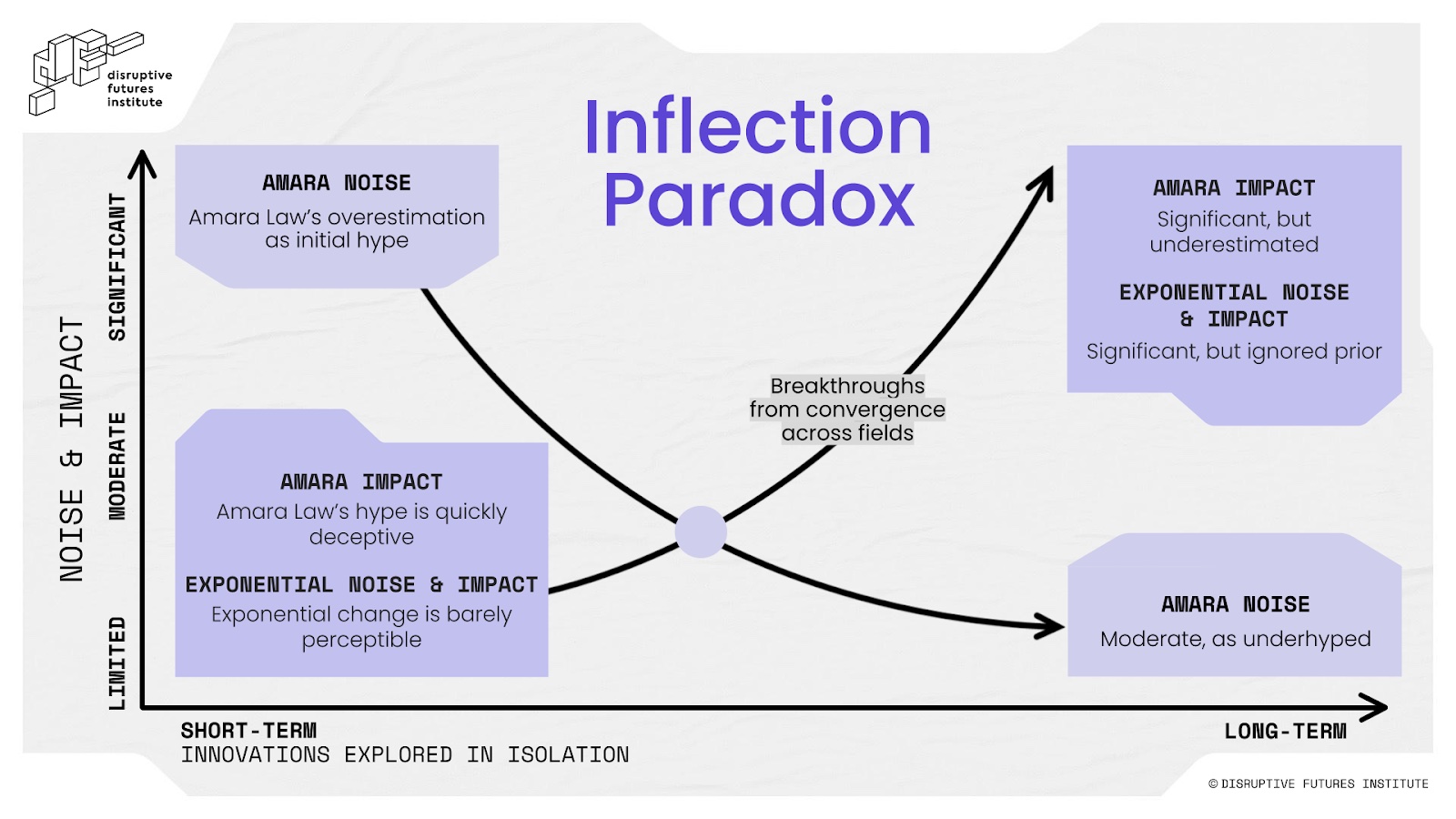
The confluence of breakthroughs across fields (e.g. information, science, biotechnology, AI, space) reaches inflection points ever faster. Inflection points are missed for two contradictory reasons:
- Amara’s Law is a key contributor to missing inflection points: Emerging innovations are overhyped and their impact overestimated at the early stages, while we underestimate long-term impacts.
- The shape of exponential change is deceptive and difficult to spot: The early developments are barely perceptible. Even explosive growth only becomes apparent after some time. Longer-term, we completely underestimate the dramatic effects of exponential change.
We call this the “Inflection Paradox”. One issue which exacerbates the Inflection Paradox is that innovations are often explored in isolation. In reality, breakthroughs occur across fields. This is why change is often slow… until it isn’t.
Change is often slow… until it is not.