

In this piece, futurist Roger Spitz tells the story of « metaruptions » – the word he coined in 2019 to name a new kind of systemic disruption, why he felt compelled to create it, and how it has traveled since.
The limits of my language mean the limits of my world.
Ludwig Wittgenstein, Tractatus logico-philosophicus
Language does not merely describe the world. It shapes what the world permits us to think. When available words fail, we do not simply struggle to communicate, we struggle to act. It becomes an ontological, an existential problem.
San Francisco, 2017: changing filters
The door opened before the word arrived. When I moved to San Francisco in 2017, I made a deliberate decision that looked odd from the outside: I would spend at least 20% of my time learning outside my field of expertise, with no way of knowing what would prove relevant. That was the point. The search took me to Santa Fe Institute for an introduction to complexity science, Stanford’s d.school for design thinking, the Institute for the Future — even improvisation classes — and, repeatedly, to The Interval at Fort Mason, the Long Now Foundation’s public space.
There I kept returning to Stewart Brand’s Pace Layers: fashion moves fast, commerce slower, infrastructure slower still; culture, governance, and nature move on timescales that dwarf the others. One question from that model has followed me ever since: what happens when a slow layer — governance, say — changes abruptly rather than evolving? When the layer meant to absorb shocks becomes the shock itself? It remains one of the useful lenses through which I think about what can trigger Metaruptions.
Those changed filters are where Metaruptions began. Two years later, in 2019, when I coined the term, what it named was more sensed than seen. Scanning early signals, the emerging drivers and underlying dynamics of change on the horizon — exponential technologies converging, hyperconnectivity deepening, systems entangling across every boundary — I became convinced that disruptions would soon no longer arrive as discrete events with identifiable boundaries. They would cascade across sectors, geographies, and time horizons simultaneously, interacting in ways that generate systemic phenomena no single component could have predicted. The frameworks we used to analyze change would themselves be disrupted. There was no word for that.
The signals were nascent then. This was before the pandemic stress-tested planetary interdependence, before generative AI upended assumptions about cognition and work, before geopolitics fractured irreversibly into multipolarization, before “unprecedented” became an everyday occurrence.
Foresight culture was still heavily invested in megatrends and drivers that could be identified, tracked, and extrapolated. The conceptual foundations of Metaruptions were first published in “The Future of Strategic Decision-Making” (Journal of Futures Studies, July 2020), then formally codified and developed across the four-volume Definitive Guide to Thriving on Disruption (Disruptive Futures Institute, 2022–2023) and Disrupt With Impact (Kogan Page, 2024). With each passing year of that codification, the world supplied more evidence.
The vocabulary problem
The candidates on offer each fail in their own way. Polycrisis names the accumulation and interaction of simultaneous crises, but does not conjure a posture for navigating them. Permacrisis declares the emergency permanent — which is another way of declaring it beyond response. Both terms are analytically useful, but they flatten agency from the narrative at the precise moment when the capacity to respond matters most. The words a society reaches for in moments of upheaval shape whether people believe response is still possible. At scale, a vocabulary of accumulation or permanence becomes a vocabulary of paralysis.
Black Swans capture rare, high-impact, unpredictable events. What I was sensing was different: volatility is shifting from episodic shocks to a structural condition of the system.
Megatrend fails differently. John Naisbitt’s megatrends are slow-to-form, large-scale evolutions derived from combining individual trends.
Megatrends map out directions. Metaruptions describe collisions
Every year, we are flooded with thousands of pages of trend reports built on this logic: extrapolate the past into the future, assume the underlying structure holds, and project forward from what can already be seen. Relying on them is dangerous.
They compound flawed assumptions — with time, assumptions magnify; wrong assumptions cascade and blow up. They derive their conclusions from the past while claiming to illuminate the future. They present unrelated shifts as if they interact predictably with each other, seldom accounting for second- or third-order consequences.
They over-index technology as a driver of change. And they create a false sense of comfort, clarity, and knowability in conditions that deserve none. Megatrends map direction. Metaruptions describe collisions — which may never become visible before they happen, and change as they become so.
The coinage
Metaruptions is a portmanteau of meta and disruption, drawing from the Latin rumpere — to break. From this lineage comes rupture, interruption, eruption, disruption: moments when continuity fractures and something new becomes possible, or imposed. Prefixing that lineage with meta introduces reflexivity — a rupture in the language of rupture itself. The word names not only what is shifting, but the transformation of our frameworks for understanding change. Its recursive quality is not rhetorical. It is the mechanism.
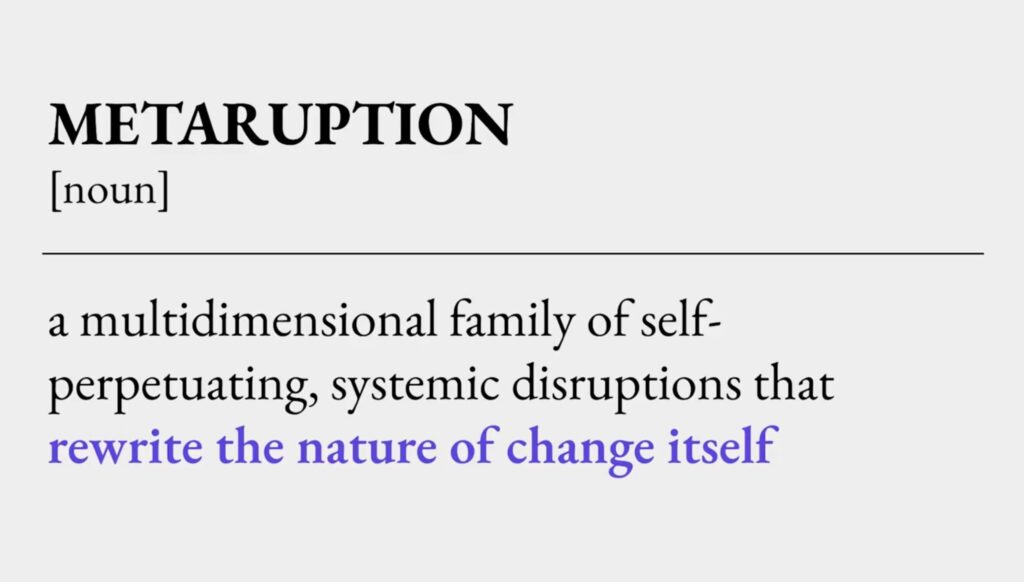
Stated plainly: Metaruptions are a multidimensional family of systemic disruptions that generate widespread, self-perpetuating effects far beyond their initial domains, including a shift in the very notion of disruption itself.
There was also another inspiration. In Japanese aesthetics, kintsugi repairs broken pottery with gold, treating fractures as sites of renewed meaning rather than damage to be concealed. Metaruptions carry this same openness: they are inherently value-neutral, leading to breakdown or breakthrough depending on our agency, mindset, preparation, and response.
“While Roger Spitz mentions John Naisbitt’s notion of Megatrends as an earlier awareness of a polycrisis, he makes a convincing case for the concept of a “metaruptions” instead.”
Jim Dator, “Thoughts on Thoughts About the Polycrisis”, APF Compass Magazine April 2025 Welcome to the Polycrisis
A lineage of disruption
Metaruptions occupy a specific position in the evolution of disruption thinking:
- Disruption 1.0 — Creative destruction (Schumpeter, 1942): industrial mutation destroying old paradigms, each cycle of destruction presumed to yield greater creation (an inherent assumption of a “net positive” effect).
- Disruption 2.0 — Disruptive innovation (Christensen, 1997): entrant-incumbent dynamics within defined sectors — agile challengers displacing legacy players through replicable, analyzable processes.
- Disruption 3.0 — Metaruptions (Spitz, 2019): omnipresent, multidimensional, systemic change in which disruptions cascade, intersect, and accelerate, generating emergent effects far beyond their original domains.
Earlier frameworks reasonably assumed the underlying system was stable enough to analyze. Metaruptions extend the lineage into conditions those frameworks were not designed to navigate — where the framework for analysis is itself subject to disruption.
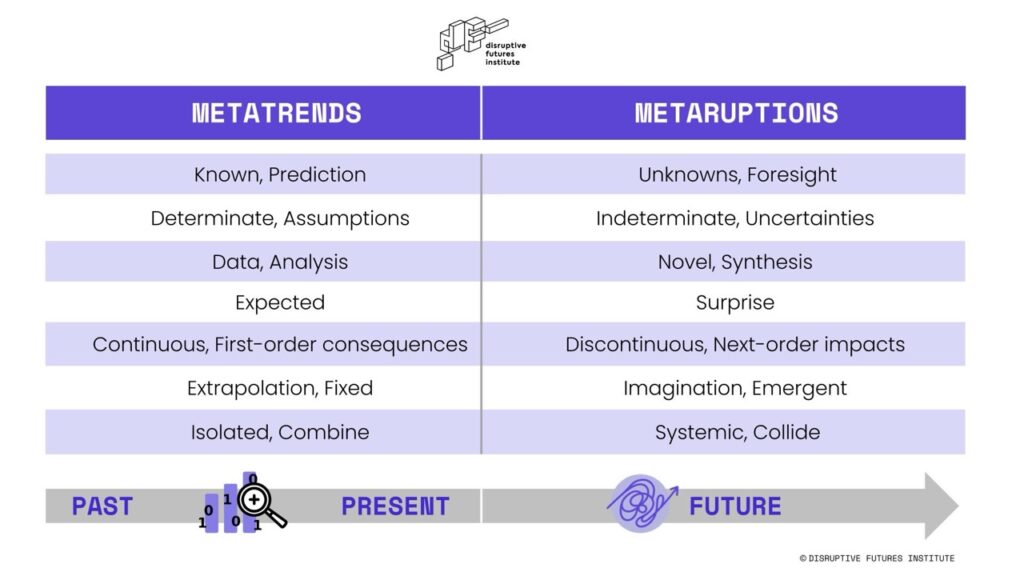
The contrast with trend thinking is structural, not semantic. In terms of their pace and shape, Megatrends are slow-forming, gradual, directional; Metaruptions can be rapid, and are discontinuous, nonlinear, complex, and self-reinforcing. Megatrends propagate in parallel — isolated, contained; Metaruptions cascade, intersect, and perpetuate themselves across domains.
Trend analysis anticipates expected, first-order effects; the most consequential impacts of metaruptions are second- and third-order — the places where disruptions from apparently unrelated domains collide and generate something entirely new: a new field, a new vulnerability, a new form of possibility that the existing taxonomy of knowledge has no ready place for.
Megatrends rely on data and extrapolation; Metaruptions demand imagination and synthesis.
If the megatrend is a telescope, the metaruption calls for a gyroscope.
There is no data on the future
Consider macro forecasting. Despite unprecedented volumes of data, economists and policymakers failed to anticipate the highest inflation in half a century — Treasury Secretary Janet Yellen, who had called the risk small, conceded “I was wrong,” blaming “unanticipated and large shocks.” The models assumed a controllable trajectory; the world declined to cooperate. The lesson is not to abandon data but to recognize what it is. All data is historical, while the purpose of every decision lies in the future. There is no data on the future.
Consider the pandemic, and cascading energy prices, food security, geopolitics, and social fragmentation. Consider then 2026. US and Israeli strikes on Iran’s nuclear facilities in late February triggered a near-total closure of the Strait of Hormuz, sending energy markets into crisis and dramatically slowing projected global trade. Geopolitics simultaneously weaponized cyberspace, with AI-enabled threats and supply chain vulnerabilities compounding what the energy shock had already set in motion. Each amplified the other, cascading uncertainty across domains. In June, new Fed chairman Kevin Warsh dropped forward guidance and declined to submit his own interest-rate projection — the world’s most influential forecaster, amid deep uncertainty, declining to forecast its own next move.
This is where Metaruptions become visible: where domains collide simultaneously. What appears as a geopolitical crisis may in fact be a metaruption — a reconfiguration of the conditions under which geopolitics itself operates, destabilizing one order while creating the conditions for another to emerge. Geopolitics no longer pivots on diplomacy or military posture alone; the landscape is hybrid and liminal, configured by supply-chain exposure, technology bottlenecks, contested control of critical resources, weaponized trade regimes, and information wars. Multipolarization — a dispersal of power across state, non-state, and decentralized networks — amplifies deep uncertainty and forces questions traditional strategy can no longer answer: Who leads? What rules prevail? How are crises resolved? What fault lines will cascade into irreversibility? The same reconfiguration is underway at the same moment across AI and human cognition, biotechnology and the conditions of life, climate systems and the economics of survival.
No domain is insulated from the others.
How I use it
The word is a working tool, not a label. Naming the phenomenon reclaims agency: we move from being surprised and disrupted to becoming architects of our imagined futures.
In practice, the concept anchors the AAA capabilities we developed at the Disruptive Futures Institute (Antifragile, Anticipatory, Agility) introduced in the same 2020 Journal of Futures Studies article, and since applied by boards, institutions, and governments confronting compounding uncertainty.
The purpose is preparation, not prediction.
The distinction is practical, not semantic: a leadership team that sees a polycrisis audits its exposure and braces; one that sees metaruptions builds the capacity to keep deciding as conditions reconfigure. Metaruptions demand that we not rely on what seems understandable or controllable. Instead: What questions should we be asking? What are the higher-order implications? What lies beyond what we can currently see? What is it to be future-prepared, resilient, and relevant in a world of metaruptions?
How the word traveled
Since its coinage, Metaruptions has crossed languages and disciplines. The term now circulates in Japanese as メタラプション (Forbes Japan), in Brazilian Portuguese as “metadisrupções” (CNN Brasil, Estadão, MIT Technology Review Brasil), in French as “métaruptions,” and in Korean and Indonesian media. A Forbes contributor independently named “Metaruption” a 2026 Word of the Year, since translated by Forbes Japan.
Beyond media, the term has been referenced by the World Economic Forum, the International Training Centre of the UN’s International Labour Organization (ILO) — whose 2026 Futures Toolkit, focused on the future of work, opens with it — the UK National Preparedness Commission, the CFA Institute, IDOS (German Institute of Development and Sustainability), and the Association of Professional Futurists. The professions themselves are engaging with the term as they confront their own futures: the Institute and Faculty of Actuaries, the Institute of Chartered Accountants, the Institute of Directors in India, and the American Institute of Chemical Engineers (AIChE).
The word has even reached canvas: British artist Dylan Gill discovered the term while searching for a title for his painting Metaruptions — we later met for a broadcast conversation in London. Before we had ever spoken, we had arrived at the same concept through radically different disciplines — one through strategic foresight, one through paint.
An emergent word for an emergent world
In 2019, the word preceded the world’s recognition of what it named; precisely the role a new word is meant to play.
Seven years on, the world has now caught up to Metaruptions. Each of these adoptions arose independently, across fields and geographies: the zeitgeist has since done the field-testing.
Metaruptions do not tell us what will happen. They tell us what kind of imagination the moment demands.
The crack is already gilded. What grows through it is still ours to shape.
Et vous, qu’en pensez-vous ?
N’hésitez pas à :
1. partager votre avis ?
2. nous laisser un petit mot ?
3. rédiger un billet ?