Q133 · How to educate using foresight activities?

30 novembre 2022
4 mins de lecture

In this series « deftech – behind the scenes », we propose to tell the story of the programme deftech as faithfully as possible; its choices, its challenges and above all the lessons learned.

By definition, instructing requires a transfer of knowledge and the activities covered here require interactions. It is difficult to have a test at the end of the sessions, but that would be something interesting to implement.

Usually organised over a day, these « events » are positioned on two axes: learning by having the opportunity to meet experts in a specific field, and learning by doing as well as experiencing something as close as possible to the real thing.

Learning from experts

Focusing on one technology area, these days have the goal to understand the real state of the art and challenges of these technologies, trying to get rid of the hype that can surround these areas.

The events also bring together three different type of people: people from the academy, who conduct more theoretical research on these technologies; people from the industry, who work more in research and development, integrating the technology into tangible products; people from the armed forces who will be the end user of the products. More than getting a complete overview of the topic, all these different experts get the opportunity, during that day, to meet, discuss and learn about each-others challenges, ranging from basics research until operational considerations.

Such opportunity does not happen often: you are making it possible!

Poster of a Deftech-day dedicated to human-machine interaction. Being a workshop, a conference, a presentation or an exhibition, the goal of these days is to provide an opportunity for the armed forces to meet experts from the academy and from the industry. Better understanding the requirements and expectations of each stakeholder, it becomes possible to get a more realistic idea of the possibilities and readiness level of a technological domain and therefore differentiate the hype from the real. The images used in the recent posters come from the science-fiction museum « Maison d’Ailleurs » as we realized that most of topics investigated today were already designed in the 1950’s and 1960’s.
Is the future of today so different than the future of yesterday?

Learning by doing

We can debate if one is at the heart of the other, but for sure, in complement of being an activity, technology foresight is also, and maybe above all, a mindset. You can improve that state of mind and mentality by training it, by experiencing different methodologies leading you to open yourself to new possible futures. Get aware of the cognitive biases and move beyond. Organizing foresight sessions where participants follow a defined methodology to reach a common identified goal is a way of doing it.

Not only will the participants discover a new way of looking at things, but they will be able to repeat the experience, maybe on another complementary topic or going more in details on something of their specific interest. Only by letting your stakeholders realize and experience by themselves the value gained by that exercise will you gain convinced and informed supporters.

Challenges and lessons learned

  1. Starting these different activities work best if they happen with a given frequency. As it requires time to organize them, don’t be too greedy. Also consider that people attending these events will most probably have to take time off from their daily work. In our case 3 events per year seems to be a good manageable number.

  2. You will have to start with your first event. You might experience some disappointment with respect to the participation. It is ok. Remember that you have to establish your brand and like for new products, you have the innovators and the early adopters. But you are here for the long run. Learn from that first experiences. Adapt and modify the format, work as well on the experience of the participants and the early and late majority will follow!

  3. A lot of formats and methodologies have already been developed and are freely accessible over the Internet. Use them! However, before doing so, make sure that you understand the context and the goals they have been developed for. Before using them, they might require some customization to fit your work environment. In our case, we put a lot of effort into preparing the material and facilitating the emergence of the questions that participants should ask themselves, in order to reduce the time needed for the exercise. Moving from an initial one-week exercise to a one-day session requires some adaptations, from how to run the process, to the expected deliverables. But you’ll have to do it, as the worst thing you could do would be just to keep the process, but shorten the time dedicated to each activity!

  4. As you might not have hindsight with regard to the methods used, why not try to work hand in hand with the academy on that specific topic. You provide the pragmatic testing environment foresight researchers might be missing, and in exchange the program could benefit from in depth analysis and theoretical support. Ideal process exchange.

  5. Plan for participants to have fun, whatever that could translate in within your environment. Nobody likes boring.

Perspectives 2022-2023

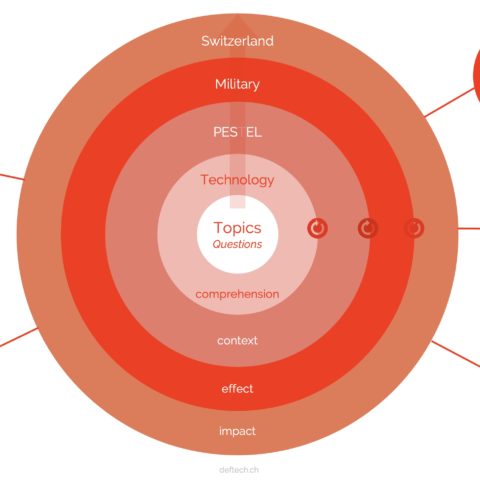
Following these different experiences, the activities of the scheme will be based on the creation of an interactive learning path. The different activities will focus on the technological aspect of the chosen themes as well as on their possible societal (PESTEL) and military impacts. The theme will be approached through different lectures and workshops. The resulting information products will be presented in the form of thematic notebooks integrating individual and collective reflection exercises.

The Augmented Soldier and Autonomous Systems are what can be considered the pilots for this series. As always, the form and treatment of the themes will evolve with creativity and originality over the course of the iterations! Stay tuned!

First episode of the serie
« deftech.exploration » aiming to explore in a didactic way the effects that the evolution of technological fields can have as well as the convergence of some of them.
Second episode of the serie
«deftech.exploration »

Laisser un commentaire

Your email address will not be published.

Ce site utilise Akismet pour réduire les indésirables. Découvrez comment les données de vos commentaires sont traitées.

Article précédent

Q133 · Comment instruire à partir d’un dispositif de prospective ?

Article suivant

Q113 · How does systemic disruption change the rules of strategic planning?

Ne manquez pas

Q357 · Existe-t-il une prospective mexicaine ?

Existe-t-il une prospective mexicaine ? C’est une

Q357 · ¿Existe una prospectiva mexicana?

¿Existe una prospectiva mexicana? Es una pregunta

Q348 · « Quelle heure est-il ? » est une équation à deux inconnues

Au-delà des considérations transcendantales concernant le Temps,