Q135 · Why vary the content and form of the topics in a foresight program?

1 janvier 2023
6 mins de lecture
FantasIA est une expérience sonore interactive et prospective dans laquelle l’auditeur joue son propre rôle.

In this series « deftech – behind the scenes », we propose to tell the story of the programme deftech as faithfully as possible; its choices, its challenges and above all the lessons learned.

Starting the different activities described in the previous chapter will necessarily take some time. What you will find out, however, hopefully as a direct consequence of your work, is that the questions you are trying to answer evolve over time.

From a simple list, their description and their readiness level, technologies are in fact interesting considering the type of change, if not disruption(s) they can bring. What is now of interest is not the technology anymore, but what they offer:

  • To do new things; to offer new capabilities
  • To do things differently.
  • To change some properties within existing products such as costs, weight, power-consumption, amount of data transferred, etc., with the hope to improve them, but including also the potential to introduce some weakness and challenges in the resilience and use of the product.

It will also come to your attention that what we are considering at not narrow technology fields anymore, but rather broad technologies areas composed by a lot of other technologies interacting among them. Take into consideration that these areas can converge (synthetic biologic with artificial intelligence as an example) and you suddenly realize the complexity faced in the description of the opportunities and threats.

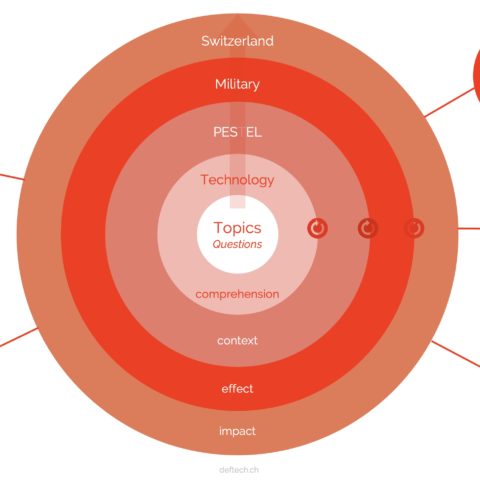
As this would not be enough, given the fact that we are in a military/defence environment, most of the research and development of the topics we are looking at are being led by the civilian industry. This simply means that considering the technology area per se is not enough anymore. To have a better grasp of its real impact, you should consider not the technology alone, but in combination with the political, economic, social, environmental and legal (PESTEL) aspects of it.

Facing such complexity, it appeared as an evidence that we needed new formats and products able to integrate it, simplify it and make it understandable. This is made possible through the use of storytelling and serious gaming.

New narratives to invent tomorrow

Since the dawn of time, stories have been the popular means of transmitting knowledge, passing on the wisdom amassed by previous generations. Stories are also the simplest format for projecting oneself into the future, testing new concepts, their coherence and attractiveness. A good story inspires, conveys values and illustrates how they can be put into practice.

There are various formats you can adopt to project the readers into what will remain for some time, a fiction. With the conviction that when you invent a word, the concept and the thing it designates begin to exist, we started creating words defining new competences, new objects, processes, jobs, even pathologies and therefore to invent some pieces of future.

You can’t think without words, and therefore without them, you can definitely not think ahead! There is no thinking without language. It is the word that gives thought its existence, says the philosopher Hegel.

Creating words to invent the future. It is obvious from the new words that are constantly appearing in our language that the future is already being invariably reinvented today. This also applies to the armed forces.
Together with the futurist writer Anne-Caroline Paucot, we have written "The Soldier of the Future", a dictionary and an online book to stimulate lateral thinking about the future of the armed forces. The example here, illustrated by French graphic designer Olivier Fontvieille, features the dataropathe, a therapist specialising in the damage caused by digital abuse. In the military, digital technology has changed the way we do, think and live our daily lives. In this whirlwind, various disorders have emerged. The dataropathe observes, analyses and treats the negative effects.

Complementary to words, we tried to give form to sentences using comics. The rational behind it is that when you mention a word or a concept, everybody forms its own representation according to its imagination and past experience. In order to create a common ground, a drawing is the most straightforward solution to iterate from.

Stories however have the defined setup that only the person telling it is active, while the one listening to it finds him·herself in a passive situation. In order to remedy this situation, we constructed a story where the reader makes his or her own choices and is confronted with their direct consequences. Using new digital opportunities, the adventure was realized in the form of a podcast, which not only gives the different characters their own voices, but also creates a sound atmosphere that makes the experience even more immersive. Carried out in the form of a survey, the different choices are recorded and analyzed. This offers unique insights to understand the importance of the context in which a new technology is used in relation to its acceptance.

But not only; starting from one possible ending, you can analyze the different paths, among them learning also the preferred one, taken by the different readers leading to it, Figure 6 . If used for the preparation of missions or operations, good practices, cognitive bias, unexpected solutions could be nicely made understandable, and allowing corrective actions, if required.

Representation of the FantasIA story decision tree consisting of a narrative and an integrated poll, available in podcast and readable format.
Developed in collaboration with the collective Le Coup d'Après, Toelt GmbH and Prof. A. Kachi (University of Basel), the graph here represents the preferred path to the J3 ending of the story. Each circle represents a question asked to the reader in the story. Depending on the answers, we can get 48 different experiences of the same story. The colour red indicates more conservative decisions towards new technologies, while the greens are clearly pro-technology, with orange in the middle. This is the first iteration of the Technocast project, which aims to experiment with new forms of statistical studies, favouring immersion.

Challenges and lessons learned

  1. As the focus must be on the technologies, their uses and resulting possible consequences, this requires a permanent effort, not to be carried away by some other topic used within the story to make it compelling.

  2. Some of the results may not please everyone. This is a fact, and you cannot do anything against it. If you have to opportunity, ask if it is the form or the substance that is causing problem.

  3. Know and present the limits and the context of the fiction. The story behind the scene could sometime be as much of interest as the fiction itself. Keep track of what the reasons were to do something like you did; why was such or such element done that way you did, and why didn’t you do it differently. This thinking and the choices made are the essence of your technology foresight program, its DNA. Keep track of it!

  4. Use the fiction as an open loop: build the narrative presenting a potential future and then consider which technologies or combination of technologies could make that future possible. Work alone or in team, to establish a roadmap to provide a possible time horizon for it be able to happen. If it will really happen? It should not be the focus at this stage, as this would be prediction. Stick to foresight!

Future Narratives

Identifying a list of technologies that will have an impact on a specific area is an important necessary step. Understanding how these effects could be requires a different, yet complementary approach.

Together with envisioning we have jointly developed several radars on various topics, all focusing more on the technologies, than on what they could enable once implemented and actually used.

This research tries to build an additional layer on top of the presentation of the technologies. What we present here has the form of a narrative where the reader is part of the decision process.

This was decided to emphasise the fact that there is no fatality and that there is always a decision involved in using or not a technology.

Exemple d'un arbre décisionnel dans lequel vous avez le choix d'être plus ou moins conservateur en matière de technologies. Être conservateur vous placera dans un environnement où ses technologies à disposition existent déjà aujourd'hui (autour de TRL 9), tandis qu'adopter pleinement les technologies vous permettra d'utiliser des technologies qui n'existent pas encore et dont certaines d'entre elles existent seulement comme idées (autour de TRL 1). 

Inspirés par les 53 tendances technologiques émergentes qui devraient avoir un impact sur les interactions entre les humains et les machines, nous avons demandé à des auteurs de science-fiction de développer quatre récits interactifs – les récits sont actuellement uniquement en anglais – de futurs potentiels ayant ces interactions au centre des intrigues.

Nous espérons que cette étape supplémentaire permettra de mieux saisir les possibilités et les conséquences que les technologies futures pourraient avoir dans ce contexte.

Nous vous souhaitons une lecture intéressante de ces histoires dont vous êtes le héros !


Inspired by 53 forecasted emerging technological solutions that are expected to impact the interactions between humans and machines, we asked science fiction writers to develop four interactive narratives of potential futures having the interactions with the technologies at the center of the intrigues.

We hope this additional step leads towards a better understanding of the opportunities and consequences that future technologies could represent in that context.

We wish you an interesting reading of these stories in which you are the hero!

Laisser un commentaire

Your email address will not be published.

Ce site utilise Akismet pour réduire les indésirables. Découvrez comment les données de vos commentaires sont traitées.

Article précédent

Q135 · Pourquoi varier le fond et la forme des thématiques d’un dispositif de prospective ?

Article suivant

#22 Hélène Cloître · Faire sécession et trouver sa voie

Ne manquez pas

Q339 · Metaruption : The birth of a new word

Language does more than simply describe the

Q338 · Foresight at the interface

It has been a few years since

Q337 · Can countertrends help to make foresight more influential?

In many organisations, the biggest challenge is