

In this series « deftech – behind the scenes », we propose to tell the story of the programme deftech as faithfully as possible; its choices, its challenges and above all the lessons learned.
One of the first activities you will consider on your way to collecting information to define the activities and goals of your program, is to find and interview the various stakeholders.
You might quickly notice that asking them what do they expect from your program is not really the most productive approach. This is not a new situation, as you just find yourself in an analogue situation as the one described by this quote attributed to Henry Ford: ”If I had asked people what they wanted, they would have said faster horses.” Your program is new and to make things even better, you are working on something that, as perceived, has little to do with the day-to-day business and preoccupations of most of the people around you.
As mentioned previously, you’ll have to act quickly to show people what kind of support and information they can expect and get from you. Following is a list of deliverables that we have been working on for the past years.
Challenges and lessons learned
- Start small, be patient; Rome was not built in one day. It might seem obvious, but it is not always easy to manage. No one knows you, the expectations of the foresight program are unclear, as well as often the notion of foresight per se. The program and its activities will have to prove themselves, quite simply.
- Be pro-active. It is easier to discuss about something concrete and iterate, so instead of coming to meetings with ideas and concepts, try to come with the prototype, the structure or with the first iteration of what you would like build. Every step forward in the concretization of an idea, is better than a plain Power-Point presentation. And this does not apply to that activity only!
- Take the time to identify, map and know your stakeholders. It is always good to understand who supports your program, who to contact in case of doubts, as well as who is not in favor of your activities. They will also be the ideal partners to build and grow your community. You have to understand the terrain. Making this program a success is, from now on, your battle. As Sun Tzu wisely stated “If you know the enemy and know yourself, you need not fear the result of a hundred battles. If you know yourself but not the enemy, for every victory gained you will also suffer a defeat. If you know neither the enemy nor yourself, you will succumb in every battle.”
Be prepared and always stay ready!
Writing a business plan forces you to consider all the aspects of your technology foresight program. From the SWOT analysis to the positioning of the program, from its branding and vision to the definition of its various products, the document should become the reference to come back to in case of doubts or challenging questions about the organization or activities of the program.
Do not underestimate the fact, obvious after you did the exercise, that you have actually a document to present about your activities. Present it to your stakeholders, force them to take position and if possible, make it official. By doing so, you will earn legitimacy within your organization, allowing you also to move towards the outside. With legitimacy comes also trust, and this is what you need to start building your activities.
Charter
The charter, which includes the vision (the aim), the mission (the purpose) and the values promoted by the Deftech foresight initiative.
Philosophy
The armed forces are not interested in technology for its own sake. Rather, they are interested in the advantage it can gain in a specific scenario, potentially through the use of technology.
Vision
BE READY ·Anticipating disruptive technologies and scenarios through synergies.
Mission
We aim to anticipate the use cases for technologies that will have an impact on how we defend and safeguard Switzerland’s security. The identification and acquisition of expertise in detecting and analysing these various use cases and technologies will be achieved by fostering synergies. These synergies will be internal to armasuisse S+T, in cooperation with the armed forces and the relevant bodies, both in Switzerland and abroad.
Motto
Anticipate, Inspire, Inform, Instruct, Impact (AI4)
Values
Our values and philosophy reflect the importance of the responsibilities entrusted to the program. To this end, we adhere to the following fundamental principles:
- Honesty and scientific integrity in all that we do.
- Objectivity in all decisions
- Neutrality in all reasoning
- Consideration of the short and long term
- Consideration of the civil and military implications, including the legal, ethical, economic and political aspects surrounding these technologies.
Challenges and lessons learned
- Within the business plan should also be integrated the identity of the program, its vision, mission and values. Do not underestimate this part, as most probably you’ll have to fight for it internally. Claiming for an identity within an organization might not be that easy. Establishing a verbal (name) or visual entity (logo) is definitely worth the challenge, as you would like people to identify the provenance of the information products, and at a latest stage to identify themselves with the brand you are building. Do it, no matter how and how big the administrative challenges are. Your activities need to be recognizable to be recognized.
- Call your deliverables « products » or « information products ». You will realize that it adds credibility and valor to your activities, much more that by calling them reports or workshops. Your product could be a report, this is not the point, but it is much more intuitive to associate a value, a cost, a road-map to create a product than to what actually “is” the product.
- Consult from time to time your business plan, either to update it or to come back to it. Nothing is set in stone and the best way to meet the expectations of your stakeholders is certainly to evolve the scheme in response to them. However, referring to what has been discussed and agreed can be a good safeguard, especially at the beginning of the process.
Visual identity
At the end of this first stage, the foresight programme took the name deftech, the acronym for « defence future technologies ». We associated it with a visual identity that we fought for and that includes three action verbs summarising the programme’s objectives: inform, educate, inspire. This terminology is used to segment and present the different products that structure the research activities.
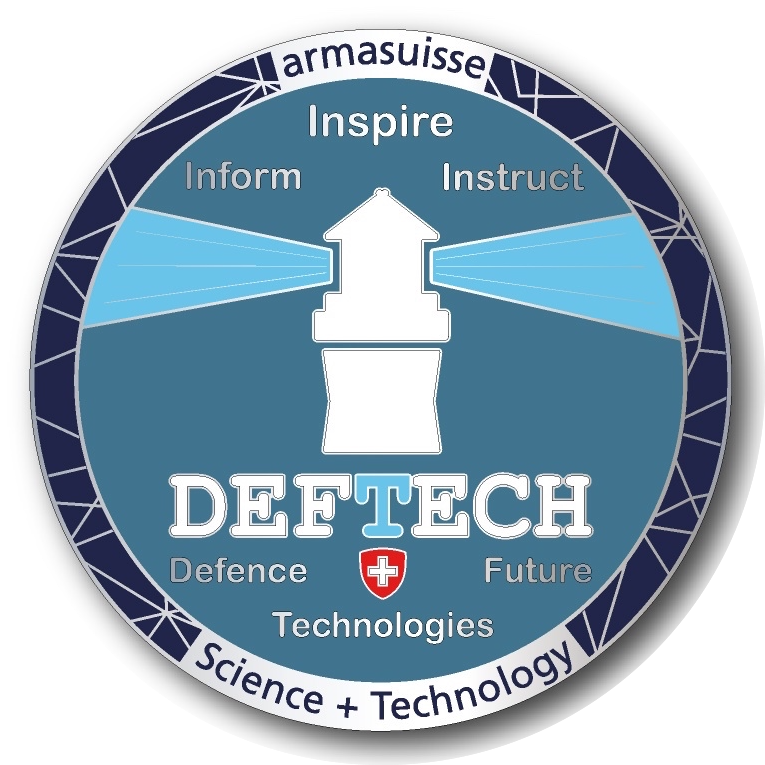
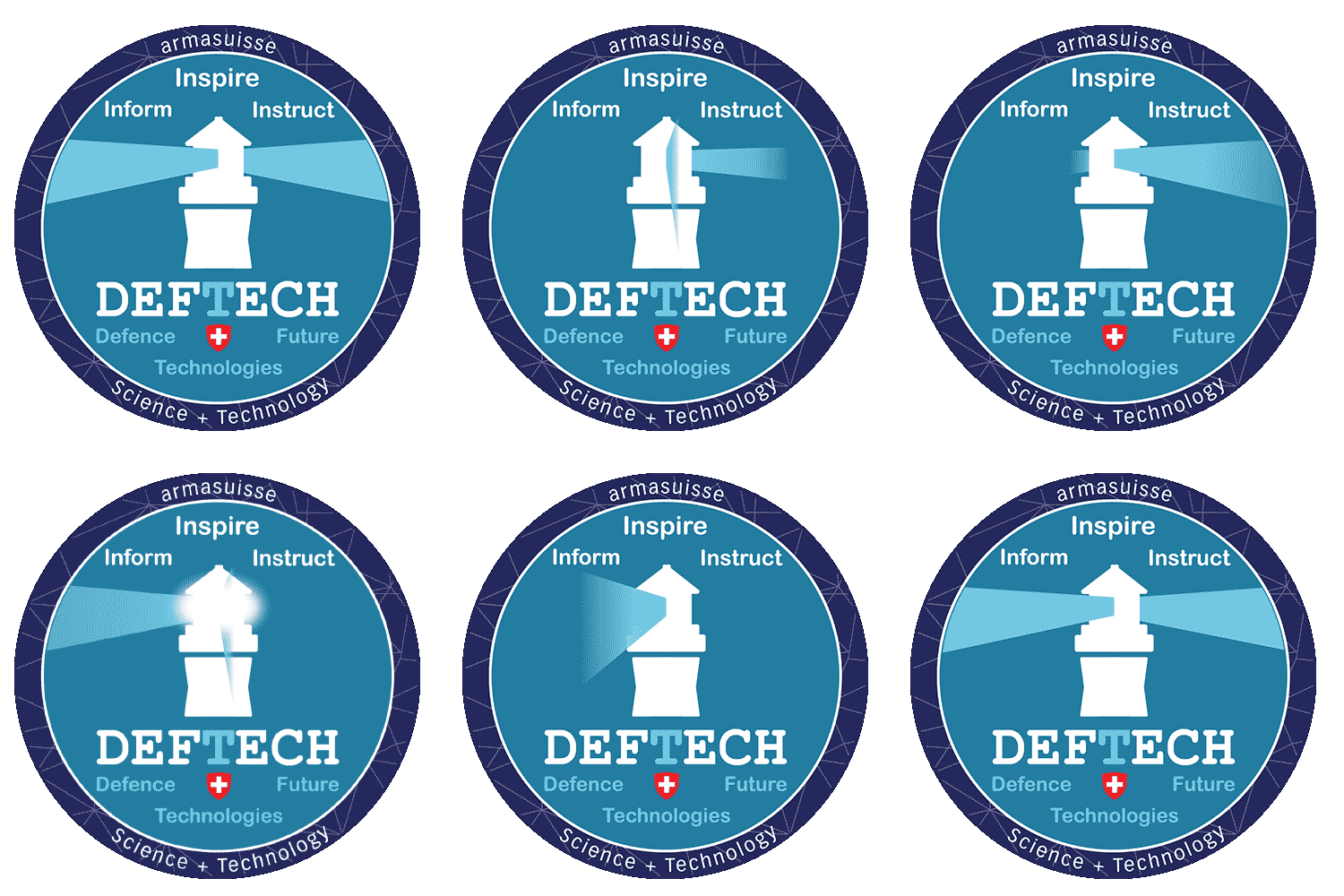
the 5 year anniversary of the foresight deftech program.
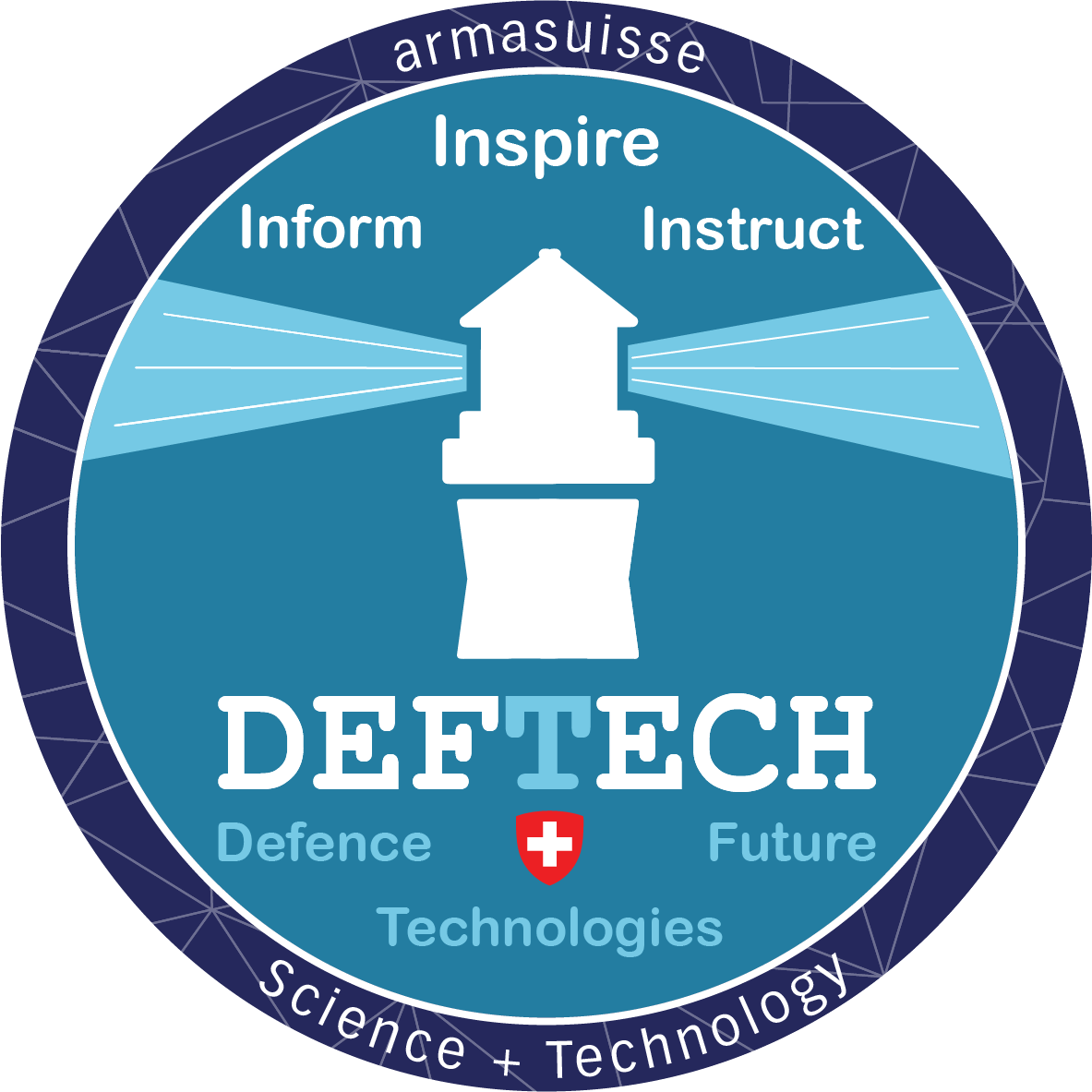
The visual identity of deftech has been created to be self-explanatory and to contain all the elements of belonging and description of the program. Recalling a military incorporation emblem, the identity is symbolized by a lighthouse illuminating in turn the 360° of the technological horizon represented by the T of the same color than the beams of light.
The lighthouse serves also as a landmark (or entry point) for the various questions related to the technological trends and their implications for the military world. The goals of the program are summarized by the 3 verbs Inform, Instruct and Inspire, the latter written slightly bigger than the previous two.
The acronym is explained by the three words Defence, Future and Technologies the latter being in the middle, as focus of the program. The three words are vertically contained within the deftech writing and symbolically protect the Swiss blazon in its middle, indicating the origin of the program.
The outer part of the medal presents a mesh, symbol of collaborations and synergies and vision of the research program. It also indicates the affiliation to armasuisse, on top, and to the Science & Technology center of competence at the bottom. This medal was created for the 5-year anniversary of Deftech.
In 2021, due to internal insistence, the visual had to be modified in order to change its shape, to no longer integrate the national coat of arms and any inscription whatsoever. We went from a logo to a visual element (but what is a logo if not a visual element!).
Not being as famous as Nike, it is sometimes useful to explain the meaning of the lighthouse. To do this, two additional text elements were created indicating the origin and the website address of the dedicated site.
The main message here is that even if external forces are pushing for change, eventually detailing the shape of some elements, see it as an opportunity to bring something new into the device. You can even call this change « evolution » and highlight it by making it visible.
Listening and being attentive to internal and external weak signals is a way to start but above all to maintain a dynamic and attractive anticipation system, which are fundamental characteristics for a good disclosure of information.
Changes to the visual identity of the deftech foresight initiative since 2013, in line with current administrative requirements.