
Through a series of articles, Bastien Kerspern and Léa Lippera tell us feedbacks (RETEX de futurs) on exciting forward-looking projects carried out by the Design Friction agency.
Article en français
The exploration
In response to the economic and social challenges of the post-Covid era, the APES association (engaged in a solidarity-based economy in northern France) launched an advocacy campaign in 2021 for a Local, Useful, Solidary, and Sustainable Production (PLUSS) to rethink the local economy beyond preconceived notions.
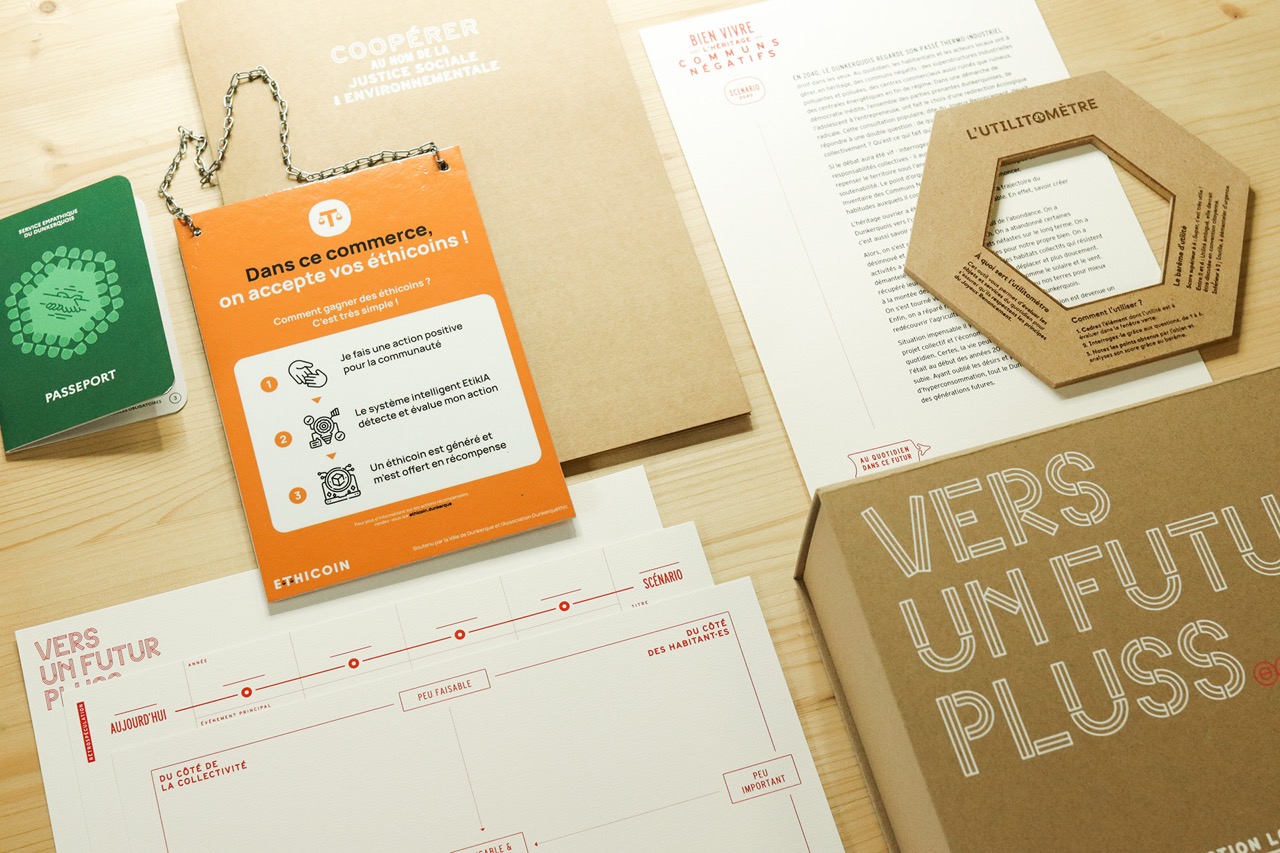
To stimulate APES’ initiatives and foster a collective debate on relocalisation, we created Towards a PLUSS Future (TPF), a futures box designed to facilitate participatory encounters between public actors, local businesses, and citizens.
Through three design fiction scenarios—focused on industrial sovereignty, socio-environmental justice, and the management of negative commons—co-developed with stakeholders in the Dunkirk region, TPF outlines possible pathways towards a more solidarity-based and sustainable economy.
Participatory by nature, the Towards a PLUSS Future experience invites people to explore, debate, and envision alternative yet tangible production models that strengthen territorial resilience in Hauts-de-France.
The insight
If Design Fiction has (almost) as many definitions as it has practitioners, one constant remains: it explores possible futures through speculative artefacts derived from these ‘tomorrows’ to tell their stories more effectively.
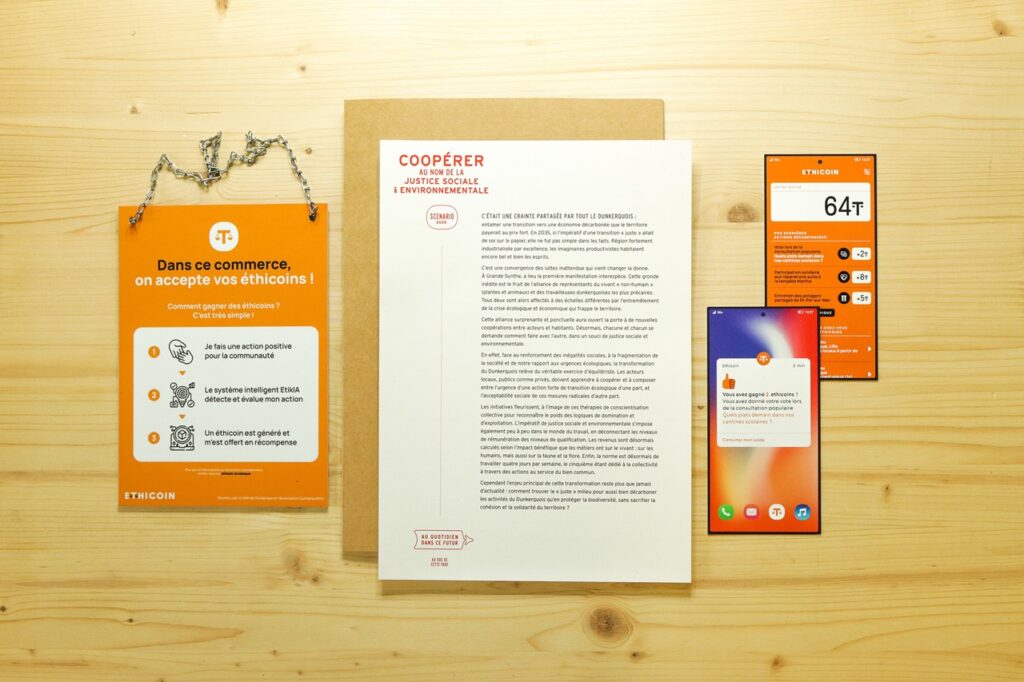
At Design Friction, we have a particular fondness for provotypes (provocative prototypes)—those objects, services, and frictional spaces that both inspire and challenge the futures of a territory, an industry, or society as a whole.
Each provotype aims to be emblematic of the future it embodies, offering a glimpse into tomorrow’s daily life and the transformations or disruptions that may come with it. Its purpose is not to become a marketable product ‘as is’ or a turnkey solution for an organisation. Rather, its role is to crystallise a possible future to catalyse stakeholders’ imagination and discussions.
In other words, Design Fiction creates fragments of what is yet to come that help frame and understand an emerging or ongoing complex issue, rather than offering a hasty or superficial answer.
provotypes (provocative prototypes)
Each provotype aims to be emblematic of the future it embodies
But how do we design the ‘right’ provotypes to effectively convey a vision of the future?
Through experience, after an intensive phase of documentation and research, we generally begin by drafting a scenario that outlines the imagined future in broad strokes.
This initial narrative sets the scope in which we will operate: the new values, rules, and practices that could emerge; the evolution of current actors and the emergence of new entities; and the risks and challenges that societal actors—both public and private—may face.
This is also the stage where we define key milestones explaining how our society has arrived at this future, ensuring a coherent, credible, and plausible projection. These milestones may or may not appear in the final scenario, depending on the objectives of the exploration and the topic addressed.
However, this written synopsis is only a first draft: it is refined through prototyping—or rather, provotyping! As mentioned earlier, our design fiction scenario must be told through one or more speculative artefacts—provotypes—to reach its full potential and allow stakeholders to immerse themselves in these futures and their implications.
The written fiction is therefore naturally subject to change during the prototyping phase. Certain aspects or details of the narrative may disappear from the text to be more effectively conveyed through an object or a visual. This is a creative compromise balancing the complexity of the subject with an exercise in empathy towards the audience discovering these fictions:
- What should remain in writing to establish the overall context of the explored future?
- What should be emphasised through prototyping to facilitate audience projection?
- What cultural codes can we subvert to help the audience step into this future?
- What imaginative barriers can we overcome by showing rather than telling?
This is precisely where provotyping becomes essential: a significant part of speculation emerges when we ‘pull the thread of the future’ by giving material form to the narrative.
This hands-on design process draws attention to details and raises questions that may have previously eluded the abstract written form. In a way, the fictional object zooms in on the crucial aspects of the written scenario:
- It makes key issues and major changes tangible and understandable, which the text alone may struggle to convey.
- It highlights the fundamental differences between this future and our present.
- It provides clues that help the audience project themselves by imagining what their personal or professional life might look like in this new world.
the fictional object zooms in on the crucial aspects of the written scenario
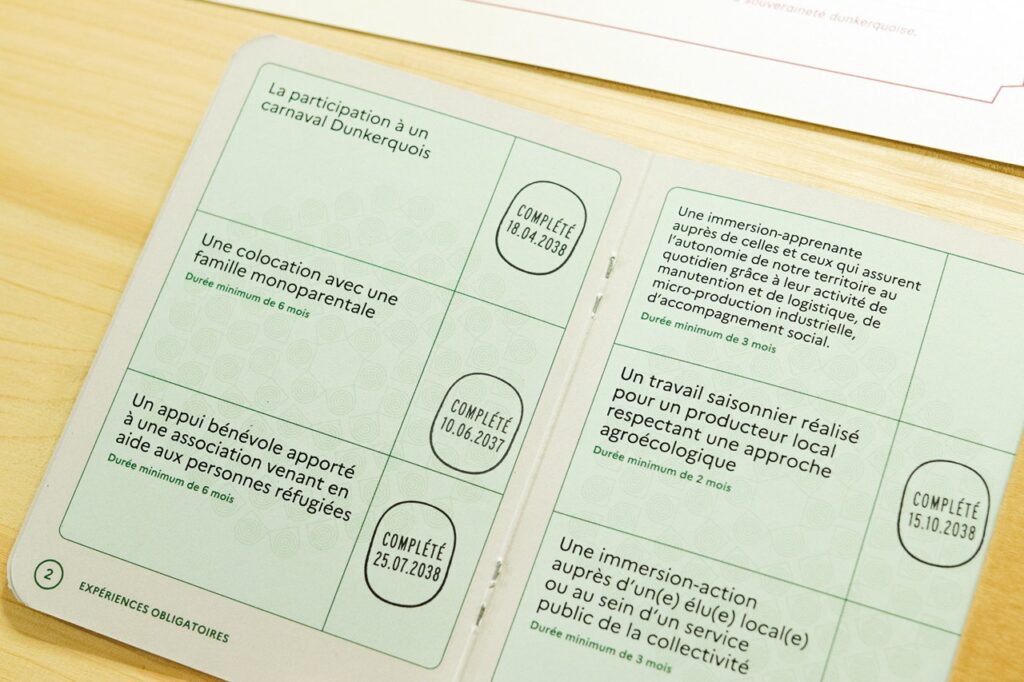
Make sure your visuals and artefacts are easily relatable.
Then comes a crucial second step: refining the affordance and self-sufficiency of the artefacts and provotypes that embody the vision of the future we wish to present.
Behind these somewhat technical terms lies a key principle of Design Fiction: ensuring that a fictional object or provotype is sufficiently explicit to require no additional explanation or mediation that might weaken immersion.
This is what we call affordance: the ability of an object or system to communicate its own use. In a sense, making a speculative artefact affording—whether it takes the form of an object, an interface, or a space—means making it more ‘intuitive’, even though it comes from a world different from our own.
Affordance and self-sufficiency are ideals towards which the design of a design fiction scenario aspires. Paradoxically, this process is facilitated by the multiplication of artefacts, each complementing and clarifying the others. We seek to create provotypes that convey a clear vision or pose a strong question about a possible future, while requiring minimal contextualisation.
Affordance and self-sufficiency are ideals towards which the design of a design fiction scenario aspires.
Over-explaining—through exhibition panels, explanatory booklets, or a mediator’s comments—risks breaking the suspension of disbelief, that crucial moment when the audience, for the duration of the fiction, suspends scepticism towards the presented scenario.
Much like a joke that needs to be explained, an artefact that is too didactic may hinder immersion and unintentionally stifle the process of projection and imagination.
We strive to ensure that artefacts, through their evocative power alone, engage the public directly, prompting them to reflect on the futures they embody without external interpretation. At the same time, to encourage discussion and ensure accessibility, we avoid producing overly ‘verbose’ artefacts.
Fictional news articles, for example, often seem like an obvious and easy prototype choice, yet their immersive impact is far lower than that of artefacts that are truly emblematic of the explored future.
Much like a joke that needs to be explained, an artefact that is too didactic may hinder immersion and unintentionally stifle the process of projection and imagination.
In short, if one rule were to be retained, it would be this:
in case of doubt about the audience’s ability to project, opt for redundant projection : combining a concise written scenario (no more than one A4 page) with artefacts designed to be as self-sufficient and affording as possible enhances understanding and discussion.
Et vous, qu’en pensez-vous ?
N’hésitez pas à :
1. partager votre avis ?
2. nous laisser un petit mot ?
3. rédiger un billet ?