
In this series « deftech – behind the scenes », we propose to tell the story of the programme deftech as faithfully as possible; its choices, its challenges and above all the lessons learned.
Starting small… one project after the other… iterate… innovate… All these were good intentions and one way to start and build that technology foresight program. After several years of existence, you will however notice that some activities that previously were done separately might gain substance and harmony if combined. There will of course be no necessity for it, but somehow you should gain the awareness that all the information of your products connected and interacting together could be something different, if not more, than every one of them considered individually.
We find that in our context, this consideration about systems, mentioned already by Aristotle, could apply to three different but interdependent levels. The technological, the informational and the managerial level, for which dedicated ecosystems could be created.
Technological ecosystem: combination and convergence
Creating an ecosystem based on various technology domains allows to make a statement of what you consider the important players in that field. Sometimes forgotten, it does also simultaneously send the message about the areas you are NOT looking at. Both signals are important.
In that artificial ecosystem, combination and convergence will happen between the technologies resulting in numerous interesting innovative ideas of systems. Time and materials being limited, restricting the fields can only facilitate a better focus.
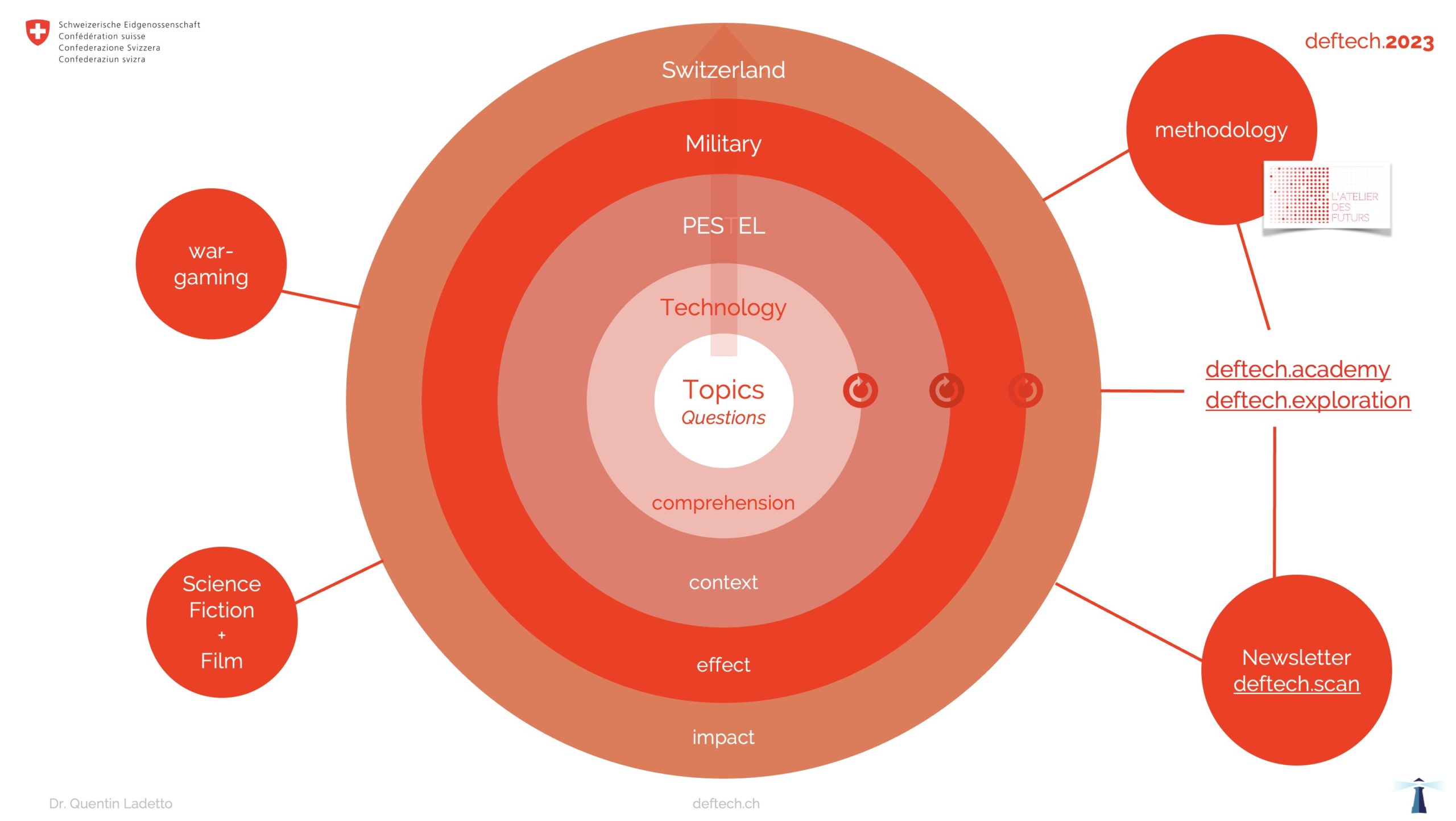
Within deftech, we have limited the ecosystem to 10 areas where applications are of interest: Artificial Intelligence – Connectivity – Robotics – Computing – Energy – New Weapons – Enhanced Soldier – Manufacturing & Materials – Sensors – Space. We are aware of the inhomogeneity of the areas and that not all of them are independent, but this was our choice. As for the other, perhaps more specialized areas, it is not that we are blind to the developments that are taking place, but rather that there are other entities (governmental or not) that provide very good analysis. The programme is based on synergies, isn’t it?
Informational ecosystem: output as input
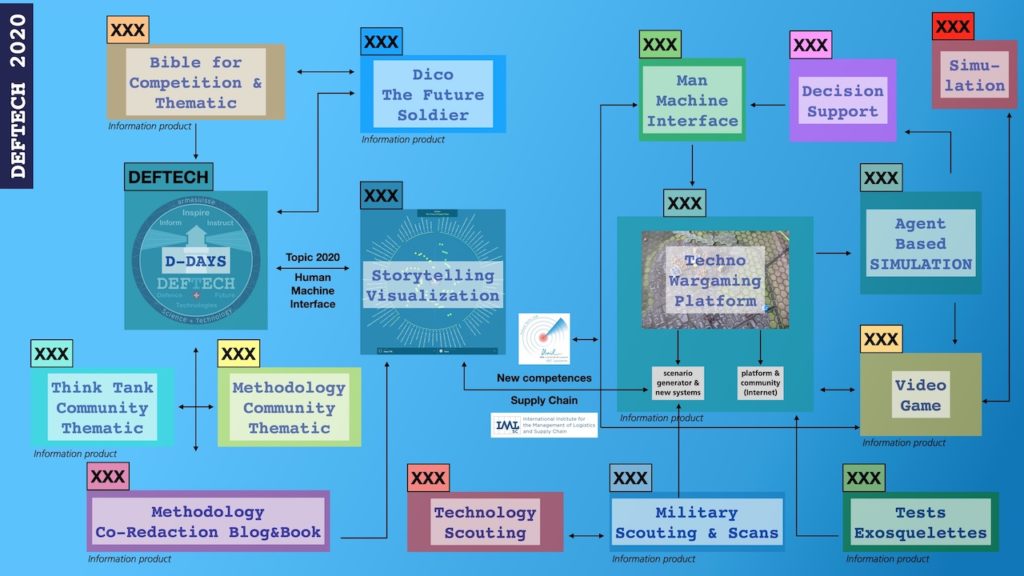
Remember that all your activities have deliverables, which you called products.
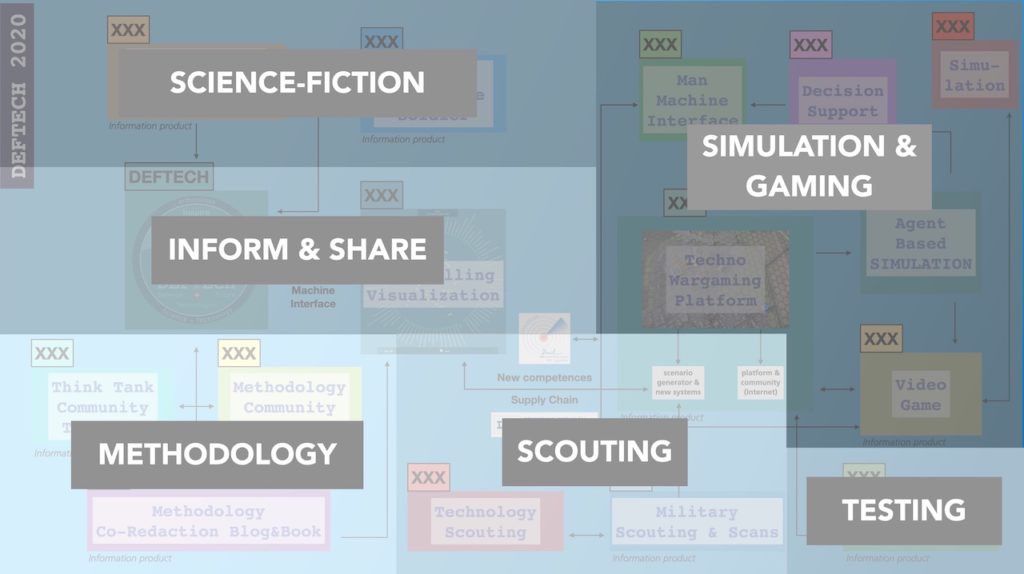
Let re-label some of them as “output”, to better consider them as “input” for the other products! Having interactions between products is a great way to leverage individual competences, efforts and create open the door to new formats and related experiences
Managerial ecosystem: collaborative win-win
Considering the global budget available for the different foresight activities, it is not reasonable to think that you can finance the creation of competences “from scratch”. However, defining the research topics in a certain way and dedicating some effort to find the right research partners, should allow to create nice win-win situations. Such situations are most of the time limited to the various projects per se, as the program manager is the only one to have the overview of the program, not the partners. There is nothing wrong in doing so, but some unseen opportunities could be left on the table.
In order to remedy the situation, one can stimulate the different entities to collaborate, by first presenting the “big picture” and introducing your partners to each-others. Incentivizing them to suggest new joint projects could be a way to softly walk the talk. This approach requires of course some trust among the players, and desire to do it. Once again, this requires some time and continuous stimulation, but succeeding one can only enjoy the benefits and advantages of such dynamic.
Challenges and lessons learned
- Encourage interactions, without creating dependencies where they are not necessary. If absolutely necessary, be aware of this and find ways to mitigate delays or difficulties that may arise between actors. Working with minimum viable solutions can be an elegant way to save time when necessary.
- Avoid competition between the various partners of the program. Acknowledge the potential and the fact that some topics could be covered by different entities, but give clear goals of who is doing what for a clear understanding of assigned roles. Roles can change over times, but must be without ambiguity for defined periods.
- Managing collaborations is a known challenge. In the context of foresight, but not only, cooperating too long with the same partners creates the risk of growing some biases. At the same time, building relationships requires time. Explaining why you change orientation and try something different is generally well understood and might as well generate some other ideas for the universe to absorb. Being transparent and open with your partners is definitely something to put on the top of the list to when stopping or putting some activities on hold.
- Manage the foresight program by alternating periods of reflection, open to exchange and dialogue with your various stakeholders, with periods focused on the implementation and concretization of the decisions taken. Reflection, realization, reflection, realization… organize activities with a similar rhythm as dolphins are moving in and out of water to breathe. Define the moments open to change and those dedicated to action.
After almost 10 years of existence, the Foresight Program of armasuisse Science and Technology continues its journey, more than ever convinced of its initial vision: To anticipate disruptive technologies and use cases through synergies.
Whether these synergies are internal to the DDPS department, to armasuisse or external with other entities or simply on projects, it is only by remaining open to all ways of thinking, to all hypotheses, that the system will fulfil its mission: to anticipate in order to better defend and preserve security.
Are you ready to join ?