
Q338 · Foresight at the interface

1 juillet 2026
6 mins de lecture

In this series « deftech – behind the scenes », we propose to tell the story of the programme deftech as faithfully as possible; its choices, its challenges and above all the lessons learned.

It has been a few years since episode 8 of the Deftech · Behind the Scene serie was written, and whilst things have been anything but plain sailing in the meantime, the adventure and the challenges that come with it remain as exciting as ever.

During this period, we saw the retirement of my boss, Hansruedi Bircher, followed a little later by the Chief of Armaments and the Chief of the Armed Forces. In terms of current affairs, we are witnessing wars in Ukraine, Gaza and Iran, as well as a somewhat new geopolitical landscape that is heightening the sense of urgency in Europe and for Switzerland in particular. In short, the situation has changed, needs have evolved, and our foresight framework is naturally adapting accordingly.

In line with organisational changes, there are now two of us – thanks to Dr Kilian Wasmer – working on anticipation and foresight. Whilst the terminological distinction is not yet entirely clear, we have opted for a pragmatic division of tasks between content production and dissemination. As our objective remains unchanged – to have the greatest possible impact on our various stakeholders – the steps and actions to be taken had long been identified; it was only their implementation that continued to fall short.

De la créativité à la production : comment utiliser un groupe de personnes intermédiaires et d'enseigner à l'enseignant - train the trainer - afin de disséminer et convertir le plus de monde possible à la pensée prospective !

One obsession: adding value

The need to add value to work carried out by third parties has been at the heart of the initiative since its inception in 2013; this is even more so today, when we feel the pressure of urgency across a whole range of projects.

How do we capture the attention of decision-makers when we rightly hear that « Operational need decides, not technology », to quote Edouard Vifian?

The answer is obvious: we must work within the system, and that means the entry point is the ‘operational need’. However, we must be wary of the danger of focusing solely on today’s operational needs; our job is to anticipate those of tomorrow. We are aware of this. What matters here is finding the best entry point, making clear not the content of the deliverables we will produce, but the positioning of the foresight programme. It is then up to us to tailor the work so that it meets the needs of anticipating developments in doctrine, training, equipment procurement, and so on.

A novice might logically assume that all one needs to do is ask: ‘What are your needs?’ The reality on the ground is more complicated, and we literally ‘went hunting’ for these needs by creating various opportunities for dialogue in the form of one-day events, workshops and ongoing participation in monthly sessions, in order to collate these needs.

Needless to say, the nature and level of the descriptions gathered were quite varied, ranging from operational to tactical and strategic levels. Rather than standardising the content, we opted for classification in order to preserve the full wealth of information they contained.


« Operational need decides, not technology »

Work at the interface

The term that best defines what we are striving to achieve is the word ‘interface’, and this applies at various levels: the interface between the technological and operational worlds, between the civilian and military spheres, between academia and industry, between the existing and the possible, between the imaginary and reality… and the list goes on!  

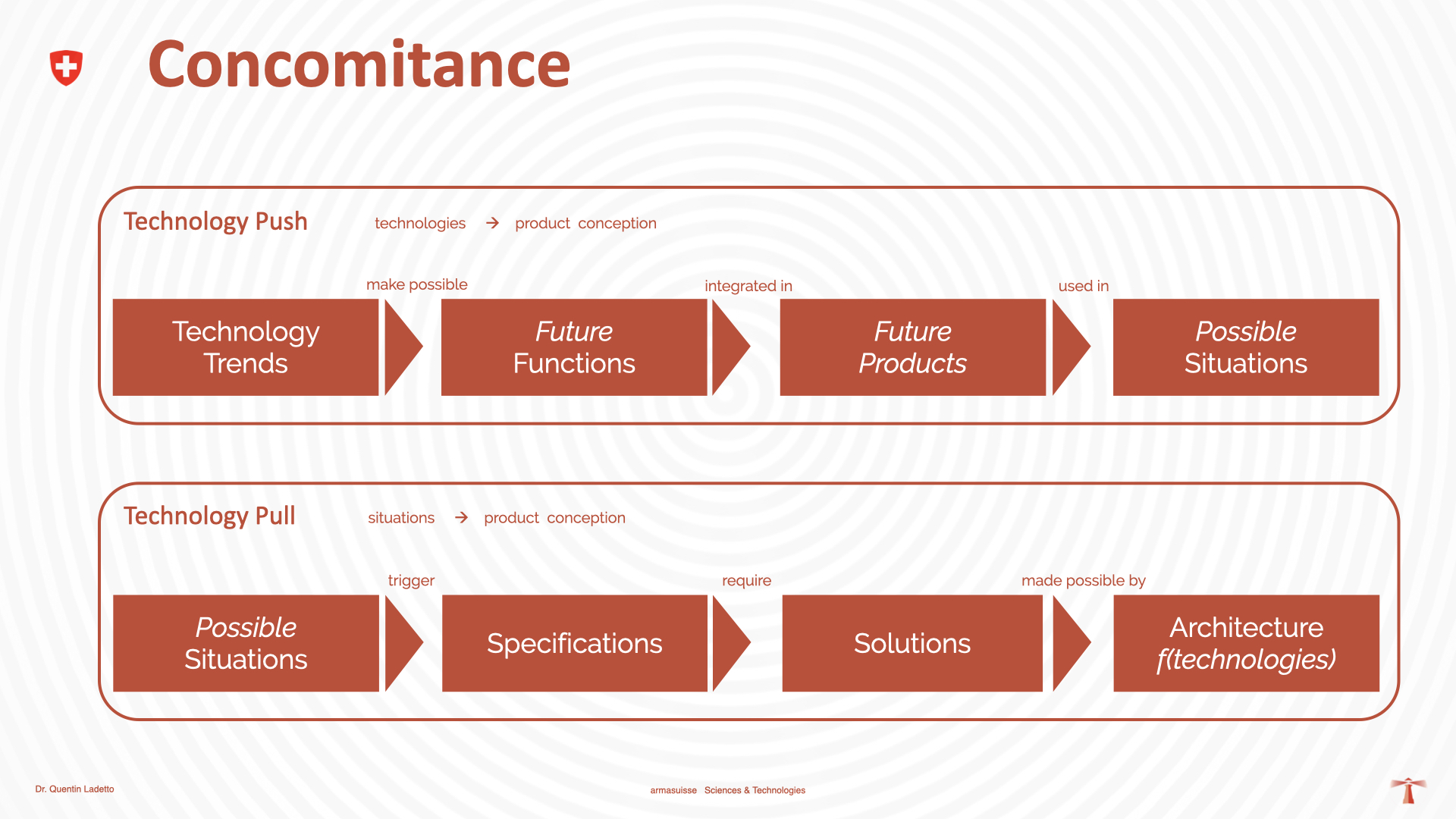
Illustration of the two foresight processes – ‘technological push’ versus ‘technological pull’ – carried out in parallel within the activities of the foresight initiative deftech
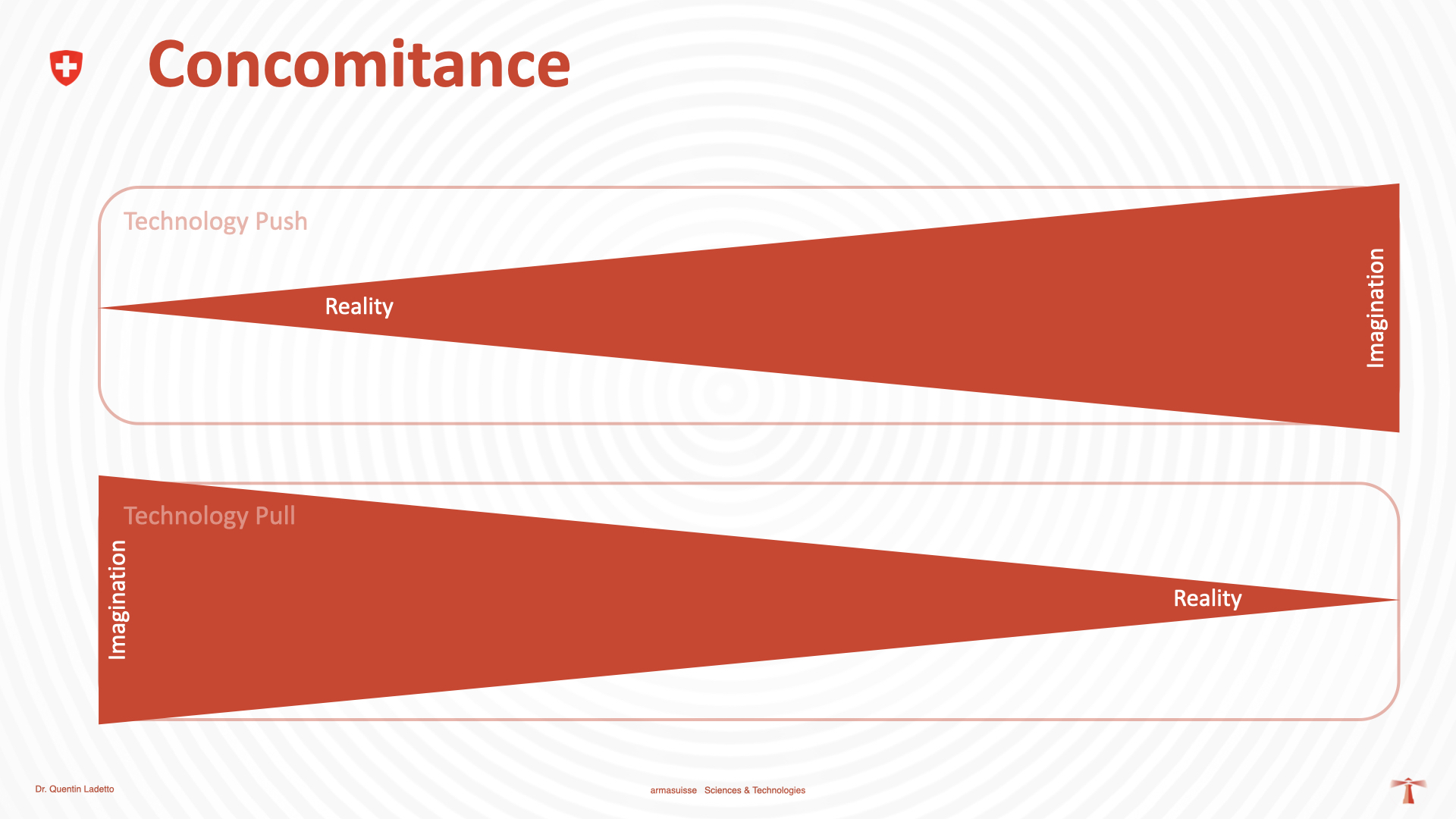
The transition from reality to imagination and vice versa in the two processes of « technological push and pull ».

The projects funded by the foresight programme serve to nourish this interface, enabling exchanges based on stimulating methodologies and processes. Here too, we value what is being done elsewhere, whilst adapting it as much as possible to Swiss specificities.

This explains the various deliverables and types of deliverables we produce, which are often specific analyses (vertical studies) aimed at understanding what changes different trends might bring about compared to the current situation, rather than futuristic overviews (for example: mobility in 2050). We try to understand what is changing, or may change, rather than projecting ourselves to a specific point in the future.

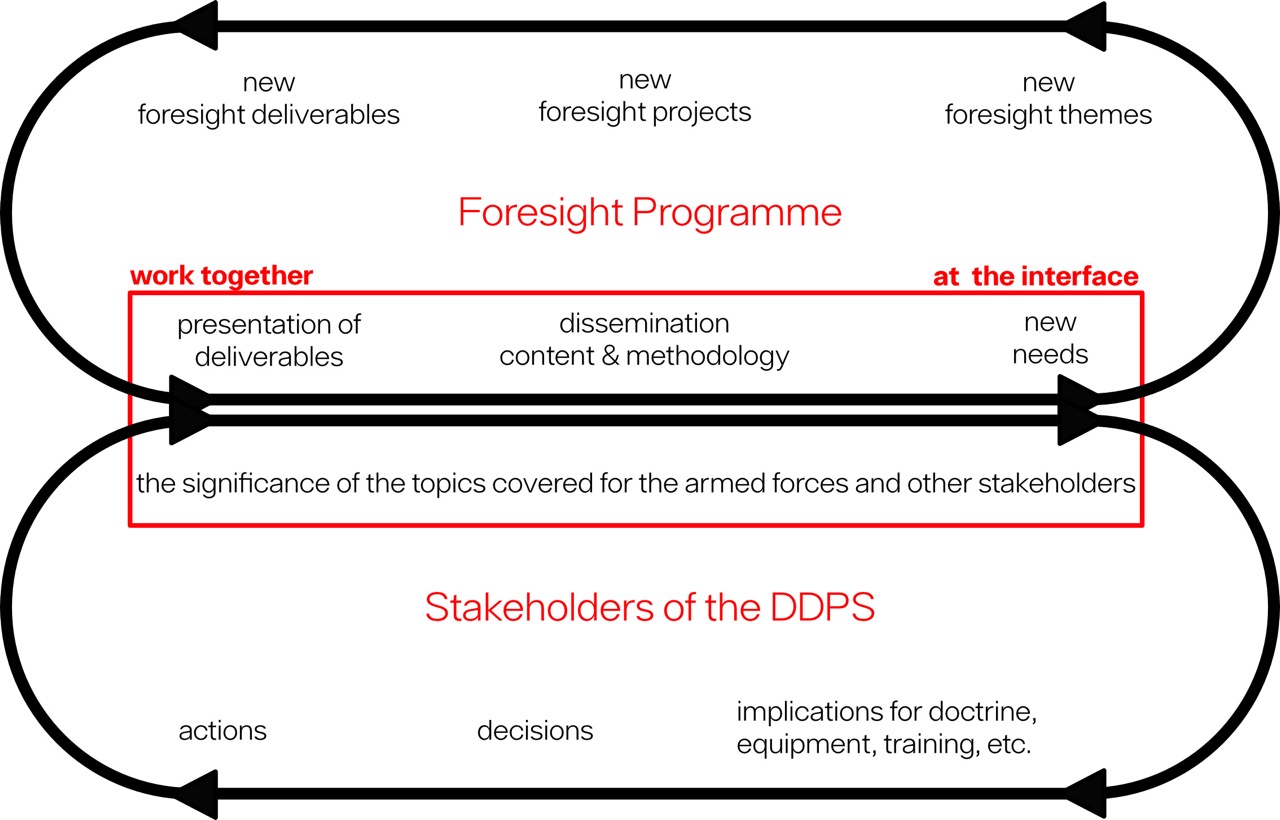
Description of the working process of the Deftech foresight initiative.
Work begins with identifying requirements in consultation with the various stakeholders. These requirements are analysed and addressed within the projects that will be responsible for producing deliverables, which will then be presented and discussed together with the stakeholders. These stakeholders possess domain expertise and are able to understand the implications for the various aspects of the armed forces, to make decisions and to coordinate the actions relating to them.
The framework operates independently during its research and development phase, just as it is separate from the decisions and actions taken at a later stage.
The more the two processes collaborate and organise their work together, the greater the chance that consideration of new opportunities and threats will lead to concrete action. Logically, the more the processes become decoupled, the less impact the foresight work will have.


In a sense, we provide the necessary ingredients for technology-based analysis, our 50%, plus a further 20% in methodology to facilitate the exchange.

Then, for the ‘recipe’ to come to fruition, we need the 30 per cent of subject-matter expertise from the armed forces to understand the implications of the prepared topic for military use cases and capabilities. We can, of course, put forward hypotheses, but these will remain merely an external assessment of the situation.

To draw an analogy with baking bread, we prepare the flour, the yeast and the recipe. We then expect our stakeholders to provide the water (which will bind the ingredients together), mix everything together with our help, and put it in the oven. It is quite simply a matter of teamwork, and it is the team that should have the pleasure of reaping the rewards (intellectually, in our case).

A refreshed identity

Alongside this groundwork, we have also updated Deftech’s visual identity by incorporating the Swiss Army’s logo in 2025, which has subtly shifted from a coat of arms to a shield.

But the main change came with the website, which, after 13 years of loyal service – albeit entirely unauthorised – had to be shut down. Thanks to the Wayback Machine, the site’s history should be preserved forever in a wholly digital eternity.

The URL https://deftech.ch now redirects to the updated dedicated page on the armasuisse Science and Technology website. Let’s be honest, with a bit of effort, this was also an opportunity to curate a selection of what was worth showcasing – the result isn’t half bad. You will also notice that the programme’s history and all publications are now hosted on this site, accessible via https://atelierdesfuturs.org/deftech/. Here too, a few adjustments have helped provide a clearer chronological overview of the programme’s activities.

All in all, we are in the process of implementing the systemic vision of ‘Three-Body Foresight’.

It takes time, requires persuasion, and above all a good dose of enthusiasm and, as always, a bit of luck!

Having passed through its infancy, the time has now come to guide the concept through its adolescence.


It takes time, requires persuasion, and above all a good dose of enthusiasm and, as always, a bit of luck!

Challenges and lessons learnt

  1. Anticipating the future means negotiating with the present. And when it comes to negotiation, I warmly recommend Marwan Mery’s books. This may seem a long way off the subject, but you’ll soon realise that convincing people to incorporate foresight into strategic thinking often—if not always—requires some skilful negotiation! And if that doesn’t convince you, you’ll no doubt find plenty of practical uses for it in everyday life!

  2. As times change, so do our concerns, and we have witnessed the growing acceptance of concepts that have been under development for a long time and which, thanks to current events, have now been thrust into the spotlight: dual-use and sovereignty, amongst others. Work on these themes is carried out either directly through a dedicated project or by integrating them as key aspects into various activities (workshops, round-table discussions, etc.).

  3. We are continuing to integrate different formats (written, audio, visual) to explore the various facets of a theme, and have experimented with the prospective novel through H20-2047. The aim is to tell a story set in a parallel reality that incorporates various foresight projects.

  4. We are trialling a new two-day format called the ‘Anticipation Platform’, exclusively for DDPS members. The aim is to present the various foresight projects and to illustrate how participants can use the content and methodology to envisage different use cases.  At the intersection of discovery and train-the-trainer programmes, we are innovating in terms of both format and duration.

  5. Rather than plunging headlong into the future, we aim to prepare participants to engage with the new, the unthinkable and the possible future. This involves food, movement, posture, and both the conscious and subconscious mind. Until now, we had focused solely on the content and how to convey it, completely forgetting to prepare the recipient – that is, the human being! That has now been rectified!

Laisser un commentaire

Your email address will not be published.

Ce site utilise Akismet pour réduire les indésirables. Découvrez comment les données de vos commentaires sont traitées.

Article précédent

Q338 · La prospective à l’interface

Article suivant

Q339 · Métaruption

Ne manquez pas

Q357 · Existe-t-il une prospective mexicaine ?

Existe-t-il une prospective mexicaine ? C’est une

Q357 · ¿Existe una prospectiva mexicana?

¿Existe una prospectiva mexicana? Es una pregunta
La première image de distribution collective de la potion dans le premier album, « Astérix le Gaulois » (1961).

Q349 · Le futur n’a pas signé votre business plan

L’ingénieur aime résoudre des problèmes, quand bien